Remote Work Tests Both Sides
Remote work rarely fails because of the idea. It fails over what each side takes it to mean: presence over results, or flexibility misused.
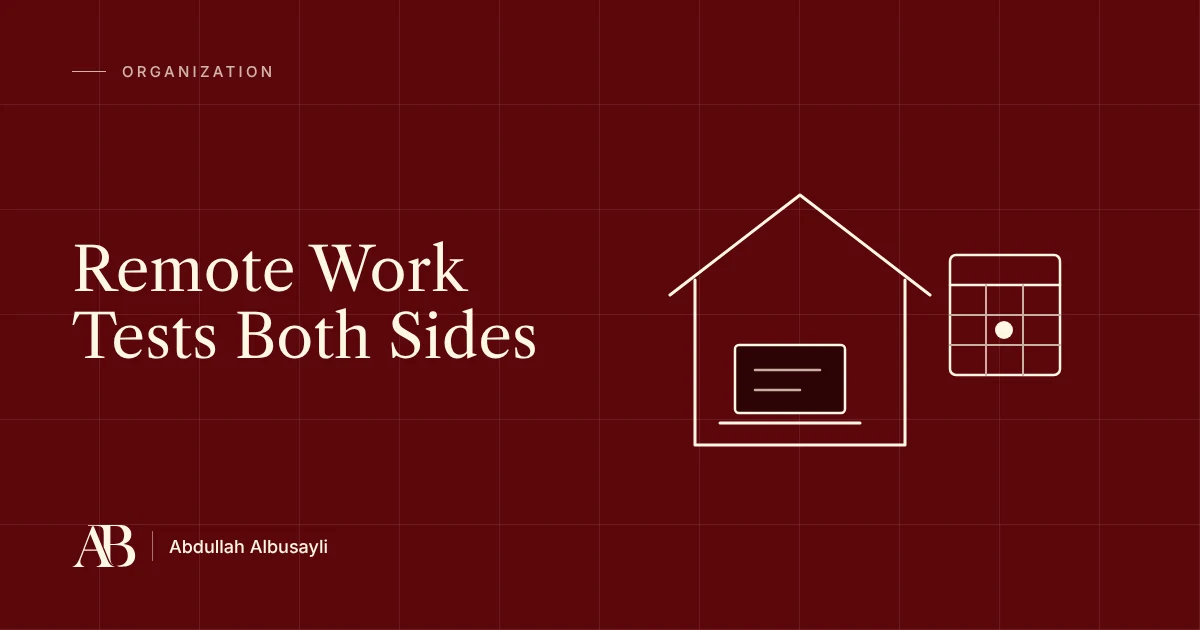
Remote work does not fail because of the idea. It fails because of what each side takes it to mean.
Today marks a year since I started working remotely. Before that, I did not prefer it and did not encourage it. I came into it because I had to: going to the office was not an option, so I had to adapt and find my own way.
Now I am one of its strongest supporters. The idea itself did not change. What changed is what I saw in practice.
A benefit on paper only
In some organizations, remote work is presented as a benefit, and everyone knows it is really extra leave. The employee is not around, the organization does not follow up, and both act as if things are fine.
In others it is the opposite. The manager treats an employee at home as someone whose whole day is available. Messages arrive after hours and at weekends, and no excuse is accepted, because "you're at home anyway, you're not busy."
The employee is part of the equation
I set aside one place at home for work, so the whole house does not turn into an office, and I got used to focusing and getting things done whenever I sit there. I also keep my calendar up to date and accurate, so anyone on the team who needs me knows when to reach me.
The employee who disappears, who is hard to reach, whose tasks wait until they are back in the office, loses first. Then they damage the idea for everyone else, because each person who misuses it hands leadership a ready reason to cancel it for all.
A test for the employer too
In my view, remote work does not only test the employee. It tests the organization too. Does it measure impact or presence? Does it respect the limits of people's time, or act as if they do not exist?
A question for you
Is remote work in your organization a real benefit, or disguised leave? And if someone needed you right now, would they know when to find you without having to ask?