Ten Years of Experience, or One Year Ten Times?
Years of service are easy to count and easy to reward. Real experience is measured by the depth of what you faced, how your thinking changed, and the weight of the responsibility you carried.
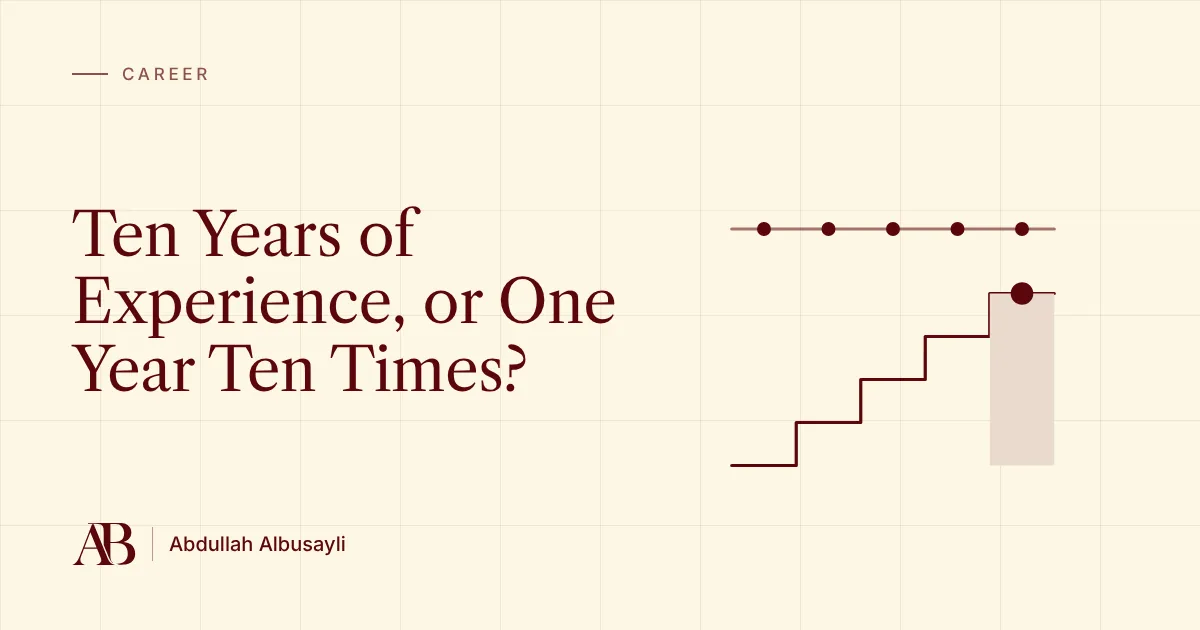
"Fifteen years of experience" is one of the most common lines I read on a CV. It is also one of the least informative.
Years are easy to count. That is why organizations reward them, and why professionals lean on them. But in hiring and in career guidance, I keep meeting two very different people behind the same number.
Same number, different depth
The first person spent ten years in roles that kept stretching them. New problems, bigger decisions, different teams, at least one failure they had to own. Their thinking at year ten is visibly different from their thinking at year three.
The second person spent ten years doing broadly the same job, competently, in the same conditions. Valuable, reliable, but in many ways it is one year of experience repeated ten times.
On paper they look identical. In an interview, the difference usually shows within twenty minutes.
What depth actually looks like
When I assess experience, for a hire or for someone deciding their next move, I look at three things more than the number of years:
- The depth of what you faced. Did the problems get harder over time, or just more frequent?
- How your thinking developed. Can you explain why you would make a decision differently today than five years ago?
- The weight of the responsibility. Were you accountable for outcomes, people, money or reputation, or mainly for completing tasks?
Why it matters for you
If you are early in your career, this is good news. Depth can be built faster than years. Ask for the harder project. Move toward problems, not away from them. Volunteer for the work that has consequences.
If you are mid-career and feel stuck, it is worth asking honestly which of the two people you are becoming. Feeling stuck is often a sign that the years are still adding up while the depth stopped growing a while ago.
And when you write your CV or sit in an interview, stop leading with the number. Lead with evidence of depth: the hardest decision you made, the problem you solved that others could not, the change in how you work.
Why it matters for organizations
Organizations that reward seniority alone send a quiet message: stay long enough and you will move up. The people who are actually growing hear it too, and many of them leave.
Grading, pay and promotion criteria that look at scope, complexity and accountability, rather than tenure, reward the right thing.
The question worth discussing is simple: are we rewarding time served, or real growth in professional judgment?